South of Fraser East Area Transport Plan
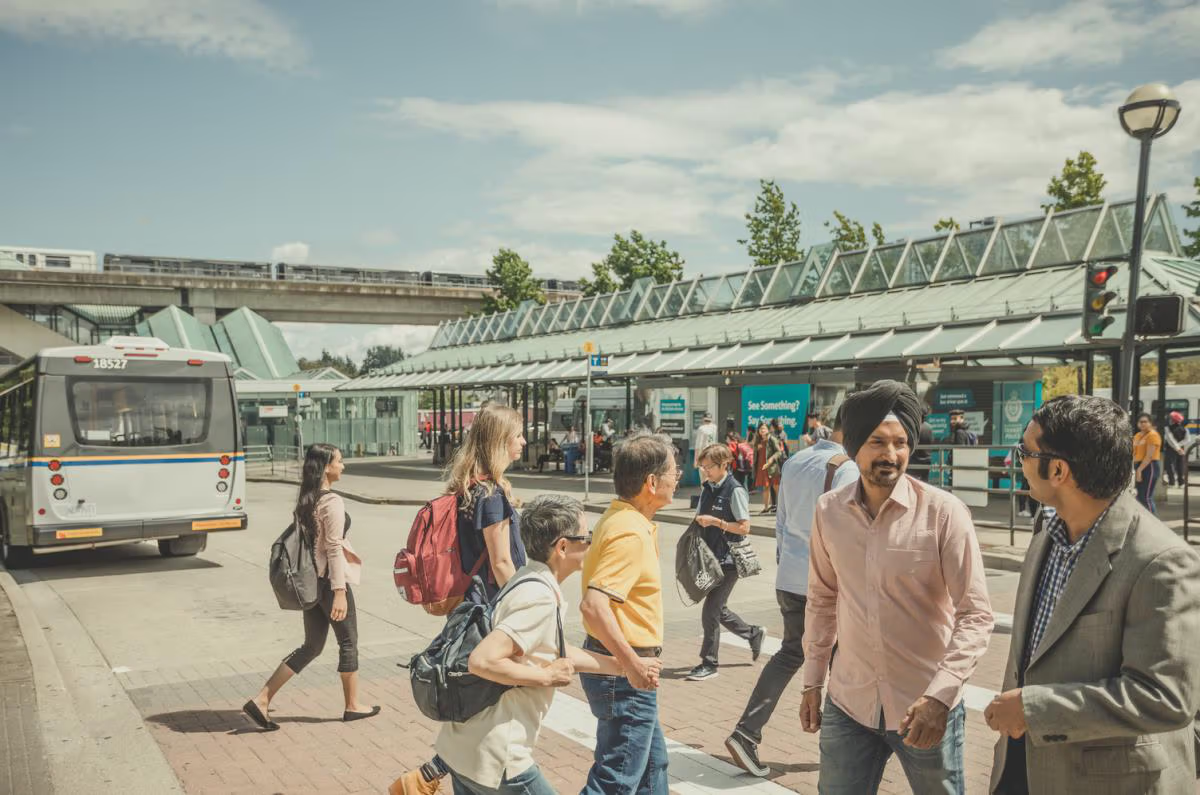
The South of Fraser East Area Transport Plan (ATP) will help shape the future of transit, cycling, walking, and goods movement within communities southeast of the Fraser River over the next 15 years.
Guided by our regional transportation strategy, Transport 2050, and its vision of ‘Access for Everyone’, the South of Fraser East ATP will help TransLink prioritize future investments in the transportation network, so that everyone can easily connect to the people, places, and opportunities they want to.
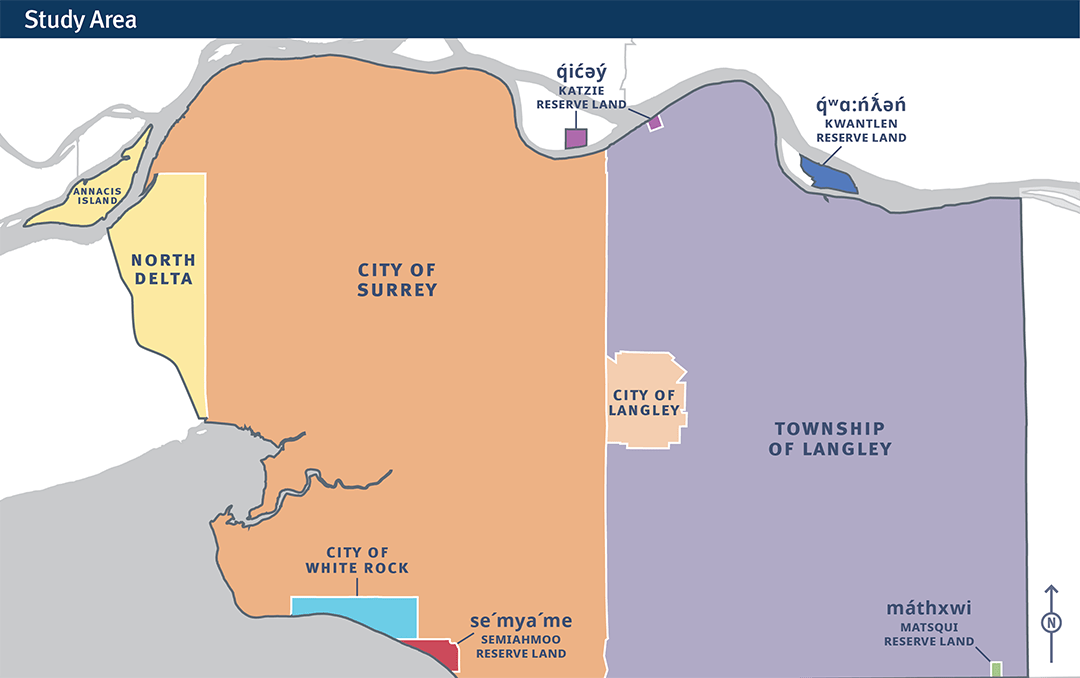
Study Area
This sub-region encompasses the cities of Surrey, White Rock, and Langley, the Township of Langley, and North Delta. The study area includes the traditional and unceded territories of several Indigenous Nations including q̓ic̓əy̓ (Katzie First Nation), q̓ʷɑ:n̓ƛ̓ən̓ (Kwantlen First Nation), máthxwi (Matsqui First Nation), and se’mya’me (Semiahmoo First Nation).
Project Scope
The South of Fraser East ATP will include actions and recommendations relating to transit, cycling, walking, and goods movement in the sub-region. Examples of possible actions include:
Introducing a new bus route in an area of the sub-region where there isn’t transit currently.
Changing the routing of an existing bus route so that it connects to a new SkyTrain station.
Working with local governments to improve accessibility around SkyTrain stations and bus exchanges so that people in wheelchairs, mobility devices, or using strollers can access transit.
Supporting local governments to introduce new separated cycling paths on busy corridors that improve safety and comfort.
Since many of the actions included in the South of Fraser East ATP will require support from external partners to implement, we work closely with local, regional, and provincial governments throughout the ATP planning process.
Phase 1 is Now Complete
The first phase of the South of Fraser East planning process is now complete. During this phase, which took place over 2025 and into early 2026, we looked at how people in the sub-region use the transportation network and how that usage might change in the future. Phase 1 also included our first round of public engagement, where we asked people who travel within the study area what’s working and what could be improved to make transit and active transportation more convenient.
To learn more about the South of Fraser East planning process, key findings from our analysis, or highlights from engagement, please see the Phase 1 Summary Report. For a more detailed overview of Phase 1 engagement and what we learned from First Nations, the public, and other transportation interest holders, please see the Phase 1 Engagement What We Heard Report.
Timeline
2025/2026
-
Phase 1: Identifying Issues & Opportunities
-
Interest Holder Engagement: Throughout
-
Public Engagement: Q1 2026
-
First Nations Engagement: At key points in planning process
2026/2027
-
Phase 2: Developing Draft Actions
-
Interest Holder Engagement: Throughout
-
Public Engagement: Q1 2027
-
First Nations Engagement: At key points in planning process
FAQs
What is an Area Transport Plan?
Area Transport Plans are an opportunity for TransLink to work more closely with local, regional, and provincial governments, Indigenous Nations, and other interest holders including the public, to develop plans for enhancing bus service and infrastructure within specific areas of Metro Vancouver, while also addressing aspects of cycling, walking, and goods movement.
Area Transport Plans are informed by and help to advance the goals and objectives outlined in Transport 2050 and Access for Everyone. Together, these plans establish the region’s long-term transportation vision, overall goals, targets, policy direction, and investment priorities.
To view current and past plans, visit our Area Transport Planning page.
Why is this plan focused on communities southeast of the Fraser River?
To make sure we understand the local needs and priorities when planning the regional transportation network, TransLink divides Metro Vancouver into smaller parts, which we call sub-regions. The boundaries of these sub-regions have changed over time as the region grows and develops.
The South of Fraser East sub-region includes the cities of Surrey, White Rock, and Langley, the Township of Langley, and North Delta. The study area also includes the traditional and unceded territories of several Indigenous Nations including q̓ic̓əy̓ (Katzie First Nation), q̓ʷɑ:n̓ƛ̓ən̓ (Kwantlen First Nation), máthxwi (Matsqui First Nation), and se’mya’me (Semiahmoo First Nation).
These communities have seen a lot of growth since the last South of Fraser Area Transport Plan was completed in 2007. Today, many of the bus routes that serve this area travel across municipal boundaries. To better understand the changing transportation needs of this sub-region, we look at each local area to learn more about how people travel and what their challenges and priorities are.
We also consider what the expected future population and employment growth is and where that growth is likely to take place. We use this information to develop actions and recommendations to improve transportation throughout the sub-region.
What is the planning process?
-
Phase 1: Identifying Issues and Opportunities (2025/2026): During this phase, we ask people about how they travel in the sub-region and study how the area and transportation network might change in the future. We also look at how people are using the transit network to see what is working and what isn’t. This helps us better understand where and what type of improvements are needed in the various communities.
-
Phase 2: Developing Draft Actions (2026/2027): During the first part of this phase, we develop a range of draft actions and recommendations that would improve how people move southeast of the Fraser River. These actions relate to the bus network, cycling, walking, and goods movement. In the second part of this phase, we ask the public for feedback on these actions.
-
Phase 3: Creating the Final Plan (2027): Based on the feedback we receive from the public, other interest holders, and additional technical analysis and input from local partners, we’ll revise the draft actions and recommendations and develop the final South of the Fraser East ATP. The plan is anticipated to be adopted in late 2027.
How is this plan different than transportation plans and priorities at the municipal level?
Area Transport Plans focus on a specific part of the region and include multiple municipalities, whereas municipal transportation plans and strategies tend to focus on a single municipality or neighbourhood within a municipality. We work closely with municipalities throughout the ATP planning process to ensure that they support the municipal transportation plans and priorities of each local area.
This helps ensure that future service improvements and other transportation investments align with what each community wants and needs. This approach also helps to ensure municipal transportation plans and strategies are aligned with TransLink’s bigger regional plans such as Transport 2050 and Access for Everyone.
Who will implement the actions and recommendations in the South of Fraser East ATP?
It depends on the nature of each recommended action. TransLink is responsible for some of the important actions and priorities mentioned in the plan, such as developing a new bus route or increasing frequency along a busy corridor to meet growing demand.
For other recommended actions, like building new or upgrading existing cycling routes, it’s the job of the local municipality or other agencies, like the Ministry of Transportation and Transit, to make those things a reality. That’s why we’re working closely with these interest holders during the ATP process.
TransLink supports these projects through our Local Government Funding Programs, which allocate funding to municipalities for active travel projects including bus priority, walking, and cycling infrastructure.
How will South of Fraser East ATP actions and recommendations be implemented?
There are a number of different ways by which recommendations contained in this plan might be implemented. For example, minor changes to bus routing that can be implemented by reallocating existing resources may be advanced through our quarterly service changes.
More significant actions, such as the introduction of a new bus route, that require additional funding or more detailed planning and design will be considered for implementation based on demand and future funding conditions alongside other regional transportation priorities.
In terms of timing, individual recommendations may be implemented all at once or incrementally over time. For recommendations that might involve trade-offs or impacts for customers, such as the loss of convenient access to transit in a certain area, further public engagement would take place prior to the implementation.